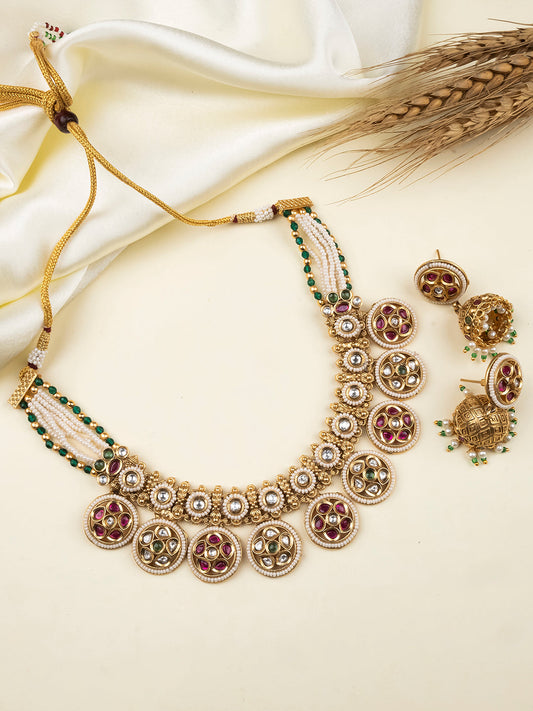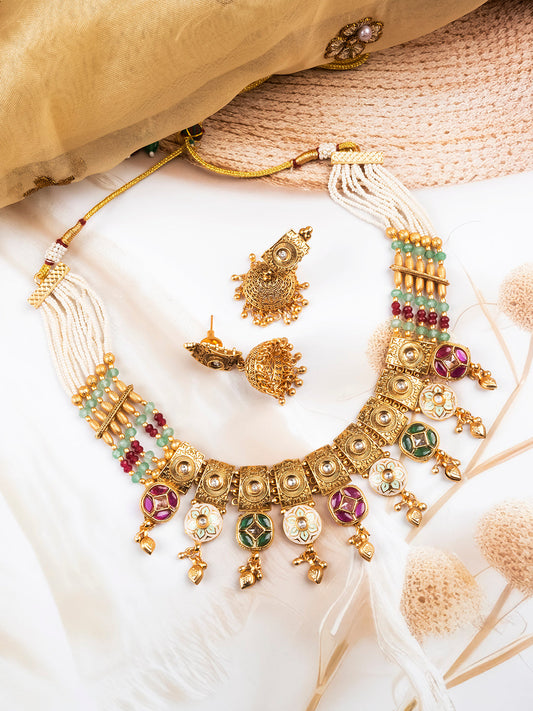

Rajwadi Jewellery — The Complete Guide
Executive Summary: Rajwadi jewellery represents the pinnacle of Indian imperial craftsmanship. Rooted in the royal courts (Rajwadas) of Rajasthan and Western India, this heritage aesthetic is celebrated for its antique, brushed-gold patina, intricate stone-embedding, colorful enamel work, and majestic, multi-layered silhouettes. Whether you are an aspiring bride curating your royal trousseau or a connoisseur of heirloom arts, this pillar guide covers every facet—from 8th-century origins and technical craft distinctions to bridal styling, pricing in India, authenticity verification, trusted brands, and local rental options.
Few adornments in world history command the visual drama, cultural pride, and regal gravitas of Indian royal jewellery. When a bride enters her wedding mandap wearing a broad, structured choker framed by uncut gemstones and vibrant enamel, crowned with a spherical bell resting gently on her forehead, she embodies centuries of dynastic heritage. This is the enduring allure of Rajwadi jewellery.
Yet, navigating the world of traditional Indian jewellery can be bewildering. How does Rajwadi differ from Kundan or Jadau? Why does South Indian bridal jewellery look so distinct? What should you expect to pay for authentic gold versus high-grade imitation pieces, and how do you protect yourself against counterfeit work?
In this definitive guide, we bring together the complete story of Rajwadi jewellery. Designed as an all-in-one resource for modern brides and heritage shoppers, we will explore its history, unpack its signature silhouettes, compare related craft techniques, break down current prices in India, and provide actionable advice on buying, verifying, and renting authentic sets.
Rajwadi Jewellery Meaning and History: The Royal Lineage
To truly appreciate these ornaments, one must look closely at Rajwadi jewellery meaning and history. The term "Rajwadi" is derived from Rajwada, a Rajasthani and Hindi word signifying a "royal estate," "palace," or "princely realm." Rather than referring to a singular technical craft or a solitary metal, "Rajwadi" denotes an overarching design aesthetic and regal philosophy inspired by the sovereign courts of Western and Northern India.

The Early Dynastic Roots (8th to 12th Century)
Long before the advent of delicate stone-setting, the early Rajput clans—most prominently the Gurjara-Pratihara dynasty (which dominated Western India from Rajasthan to Gujarat) and the Chahamanas of Shakambhari (Chauhans)—established the bedrock of royal adornment. During this medieval era, ornaments were massive, structural, and fabricated from hammered sheets of solid gold and silver. Motifs were deeply sacred and martial: the sun god (Surya) for Suryavanshi lineages, the crescent moon (*Chandra*), royal swords, and protective nature spirits. These heavy sheet-metal techniques birthed iconic pieces like the *Gokhru* (spiked cuff) and rigid neck torques.
The Mughal-Rajput Synthesis (16th to 17th Century)
The defining transformation of the Rajwadi aesthetic occurred in the late 16th century through the diplomatic and cultural alliances between the Rajput principalities and the Mughal Empire.
The central historical figure in this revolution was Raja Man Singh I of Amber (reigned 1589–1614), the trusted general of Emperor Akbar. While stationed in Lahore, Man Singh was mesmerized by Persian enameling techniques flourishing in the imperial Mughal ateliers. In the 1590s, he invited five master enamelers (Meenakars) from Lahore to settle in his capital at Amber.
These master artisans combined their Persian glass-powder fusion techniques with the local Rajput goldsmiths' gemstone methods. This cross-cultural synthesis yielded:
1. Kundan: Setting uncut stones flush into gold using refined 24K gold foil without heat or solder.
2. Meenakari: Fusing brilliant mineral glass enamels onto metal backings, ensuring ornaments were as exquisite on the reverse as they were on the front.
When Maharaja Sawai Jai Singh II founded the planned royal capital of Jaipur in 1727, he established specialized quarters — most famously Johri Bazar — for these craftsmen, permanently solidifying Rajasthan as the heartbeat of royal Indian jewellery.
The Maratha and Gujarati Expansion (18th Century)
In the 18th century, the aesthetic expanded into neighboring royal regions:
-
The Maratha Peshwa Influence (Maharashtra): Operating from Shaniwar Wada in Pune, the Maratha court integrated Rajasthani gold craftsmanship with their love for imported Basra pearls and deep cabochon rubies, creating iconic regional treasures like the pearl-encrusted Peshwai Nath, the woven-bead Thushi choker, and the spiritually protective Kolhapuri Saaj.
-
The Kutch Jadeja Dynasty (Gujarat): In Western Gujarat, local silversmiths under royal Jadeja patronage adapted court jewelry into Pachchikam, utilizing silver claw settings and glass stones to emulate platinum-set European jewelry brought by 16th-century sea merchants.
For more information about Rajwadi Jewellery meaning, royal history and styles, read our authenticity guide. Click here.
Technical & Regional Comparisons: Disentangling the Crafts
One of the greatest hurdles for buyers is separating the aesthetic style from technical processes and regional alternatives. Let us break down the three most critical comparisons.
Rajwadi Jewellery vs Kundan Jewellery Difference
Understanding the Rajwadi jewellery vs Kundan jewellery difference begins with a clear rule: Rajwadi is a style; Kundan is a technique.
-
Kundan strictly refers to the method of stone setting. Artisans shape cavities in gold or silver, fill them with natural lac resin, insert gemstones, and compress refined 24-karat gold foil (Kundan) around the edges to hold them firmly in place. Kundan pieces often feature bright, polished yellow gold frames.
- Rajwadi refers to the grand, antique royal aesthetic. It often has a matte, oxidized, or brushed finish and features traditional courtly shapes.
- The Overlap: You do not have to choose between them! A necklace crafted using the Kundan gold-foil technique, but finished with an antique matte patina and traditional Rajasthani silhouettes, is a Rajwadi Kundan necklace.
Rajwadi Jewellery vs Jadau Jewellery
Another frequent comparison is Rajwadi jewellery vs Jadau jewellery.
- Jadau (from the Hindi word Jadna, meaning "to embed") is an umbrella, multi-artisan manufacturing process. A true Jadau piece requires four specialized craftsmen: the Chiteria (designer), the Gharia (metal frame engraver), the Meenakar (enamel artist), and the Jadaiya (stone setter who uses the Kundan technique).
- Rajwadi is the thematic look. While Jadau can be styled in modern or minimalist forms, when crafted with antique finishes, massive proportions, and Rajput motifs, it becomes Rajwadi Jadau jewellery.
Rajwadi Jewellery vs South Indian Bridal Jewellery
For brides exploring diverse Indian heritages, comparing Rajwadi jewellery vs South Indian bridal jewellery highlights contrasting cultural roots:
| Comparison Factor | Rajwadi Jewellery | South Indian Bridal Jewellery |
|---|---|---|
| Cultural Heritage | Western & Northern India (Rajput & Maratha Courts) | Southern India (Chola, Pandya & Vijayanagara Dynasties) |
| Inspirational Core | Imperial court life, palace architecture, martial valor | Sacred temple iconography, sanctum rituals |
| Signature Motifs | Peacocks, royal elephants, palace arches (jharokhas) | Goddess Lakshmi, Lord Ganesha, temple towers (gopurams) |
| Primary Technique | Stone-embedding (Jadau/Kundan), enamel (Meenakari) | Solid metal repoussé (Nakshi), gold filigree, coin strings |
| Metal Tone | Matte, antique, or oxidized brushed gold | Deep, luminous, warm yellow gold |
| Iconic Pieces | Aad choker, Borla, Bajuband, Haathphool | Kasumala (coin necklace), Vaddanam (waist belt), Vanki |
| Ideal Saree Pairing | Rajputi Poshak, Banarasi brocade, Raw silk lehenga | Pure Kanjeevaram silk, Mysore silk, Kasavu saree |
Signature Silhouettes: Bridal & Festive Design Catalogue
Rajwadi jewellery is renowned for specific, iconic silhouettes designed to adorn a woman from head to toe (the sacred Solah Shringar).

Rajwadi Choker Necklace Designs
The focal point of any royal ensemble is the neckwear. Modern Rajwadi choker necklace designs fall into three primary artistic expressions:
- The Classic Rajputana Aad: A rigid, broad rectangular or slightly curved plaque that rests flat across the throat. It is bordered by clusters of pearls (moti) and cascades into dangling gemstone beads. The Aad is designed to frame the bride's face with dramatic majesty.
- The Guluband & Chich: A flexible choker made of hinged rectangular panels set with Kundan or Polki, fitting snugly around the neck. It is ideal for brides with slender collarbones.
- The Multi-Tiered Choker-Haar Layering: Modern brides rarely wear a choker in isolation. The signature Rajwadi look involves pairing a high-sitting choker necklace with a cascading Rani Haar or Panchlada/Satlada (five-to-seven layered necklace) to create a multi-dimensional royal silhouette.
Meenakari Rajwadi Jewellery Set
A quintessential expression of this heritage is the Meenakari Rajwadi jewellery set. In these sets, colorful glass enameling is integrated with antique metal:
- Traditional Red & Green (Panchrangi): The most auspicious palette for Hindu weddings, where vivid pigeon-blood red and emerald green enamels counterbalance uncut Polki stones.
- Jaipur Pastel Meenakari: A popular contemporary variation featuring powder blues, blush pinks, and mint greens, designed specifically to match modern pastel bridal lehengas.
- Reversible Masterpieces: High-end Rajwadi bridal sets feature elaborate Meenakari on the reverse side. The smooth, glass-like enamel protects the bride’s skin from metal friction while offering two distinct styling looks in a single heirloom.
Rajwadi Jewellery Designs for Bridal Wear
A complete bridal trousseau requires coordinating all complementary ornaments. The most sought-after Rajwadi jewellery designs for bridal wear include:
- The Borla (Forehead Bell): Unlike flat maang tikkas, the Borla is a hemispherical, bell-shaped ornament encrusted with Kundan, rubies, or pearls, resting on the crown of the forehead along the hairline.
- The Sheeshphool: An ornate, floral-carved hairband that frames both sides of the bride's central parting, connecting directly to the Borla.
- The Nath (Nose Ring): A delicate circular gold wire accented with a single Kundan flower or pearl cluster, supported by an ornate chain hooked into the hair above the ear.
- The Bajuband & Loon (Armlets): Rigid, curved gold plaques adorned with floral Meenakari, secured around the upper bicep with adjustable red and gold silk cords (loon).
- The Haathphool (Hand Flower): A central medallion sitting on the back of the hand, anchored by an ornate bracelet and connecting via delicate chains to rings on each finger.
- The Kamarband (Kandora): An intricate waist belt that accentuates the waistline, cinches the heavy bridal dupatta, and secures the lehenga.
How to Identify Original Rajwadi Jewellery Before Buying
Because Rajwadi jewellery involves complex layering, resin adhesives, and stone settings, buyers must be vigilant. Here is a step-by-step checklist on how to identify original Rajwadi jewellery before buying to ensure you receive true value for your investment:

Step 1: Check for the BIS Hallmark Logo
In India, all genuine gold jewellery must bear the official hallmark certified by the Bureau of Indian Standards (BIS). Look for the triangular **BIS logo** alongside the purity fineness mark:
- 22K916: 22-karat gold (91.6% purity) – common for plain gold and light stone pieces.
- 18K750: 18-karat gold (75.0% purity) – the industry gold standard for heavy Jadau/Polki Rajwadi jewelry because it is structurally harder and holds stones more securely.
- 14K585: 14-karat gold (58.5% purity) – common for budget-friendly fine jewelry.
Step 2: Scan the 6-Digit Alphanumeric HUID
Every hallmarked gold article sold after April 2023 features a laser-engraved Hallmark Unique Identification (HUID) code (e.g., `AB12CD`).
1. Download the official BIS CARE app (available on iOS and Android).
2. Navigate to the "Verify HUID" module.
3. Type in the code stamped on your jewellery.
4. The app will verify the jeweller's registration, the assaying testing center, the date of hallmarking, and the exact metal purity. If the code does not populate, do not buy the item.
Step 3: Insist on a Transparent Weight Breakdown
In Jadau and Rajwadi jewellery, a substantial portion of the piece's weight consists of lac (wax/resin), glass, and gemstones.
- The Seller Trap: Some jewelers weigh the entire necklace and charge you the gold market price per gram for the gross weight.
-
Your Protection: Your invoice must explicitly separate
- Gross Weight: Total weight of the piece.
- Net Gold Weight: Actual weight of gold alone. You must only pay the gold rate on this net weight.
- Stone/Diamond Weight: Carat weight of Polki or semi-precious stones.
- Making Charges: Explicit labor charges.
Step 4: Density & Magnetism Cues
Gold and silver are non-magnetic. If your jewelry clings to a strong rare-earth magnet, it has an iron or nickel core. Furthermore, gold is an extremely dense metal ($19.3\text{ g/cm}^3$). If a large, thick piece feels suspiciously feather-light, it is likely fabricated from hollow shells, aluminum alloys, or pewter.
5. Pricing, E-Commerce, and Trusted Brands in India
Understanding the commercial landscape allows you to set realistic expectations based on your preferred material and budget.
Rajwadi Jewellery Price in India
The market for Rajwadi jewellery price in India is tiered based on the metal substrate and stone grades:
| Segment | Metal & Stone Composition | Typical Price Range (Complete Bridal Set) | Best Suited For |
|---|---|---|---|
| Heirloom Fine Gold | Solid 18K/22K gold + raw Polki diamonds + real pearls | ₹5,00,000 – ₹25,00,000+ | Main wedding day, generational family investment |
| Gold with Glass Kundan | Solid 22K/18K gold + uncut glass (Ghat) + Meenakari | ₹1,50,000 – ₹6,00,000 | Brides seeking real gold value without diamond price tags |
| Silver Heritage (Demi-Fine) | 925 sterling silver + 24K gold plating + semi-precious stones | ₹25,000 – ₹1,00,000 | Destination weddings, NRIs, accessible fine jewelry |
| Premium Fashion (Imitation) | Brass/copper base + micro gold plating + antique wash | ₹2,500 – ₹25,000 | Sangeet, Mehendi, photoshoots, budget-conscious weddings |
Buy Authentic Rajwadi Jewellery Online
Purchasing royal jewelry online is convenient, but requires diligence. Follow these rules when you buy authentic Rajwadi jewellery online:
- Verify Photographic Integrity: Beware of websites using stolen celebrity bridal images. Reputable online brands showcase high-resolution 360-degree product videos and unedited close-up shots of metal crevices and enamel backs.
- Inspect Certification Policies: For real gold or silver, ensure the jeweler ships the physical BIS HUID certificate or a recognized gemological laboratory card (such as IGI for Polki diamonds).
- Review Return & Transit Insurance: High-value online purchases must be shipped via secure, fully insured courier partners (such as Sequel Logistics or BVC Logistics) and backed by a minimum 7-to-15-day return policy.
- Virtual Video Consultation: Leading heritage brands offer scheduled one-on-one video appointments, allowing you to see the jewellery's scale, drape, and stone luster against natural skin tones before ordering.
Best Rajwadi Jewellery Brands in India
When shopping for genuine pieces, discerning buyers turn to established names recognized for heritage preservation:
* The Royal Heritage Ateliers: Legendary jewellery houses like Amrapali Jaipur, Surana Jewellers of Jaipur, Birdhichand Ghanshyamdas, and Raniwala 1881 are celebrated globally for museum-grade Jadau and Polki masterpieces.
* National Fine Jewellery Retailers: Renowned brands such as Tanishq (with their Rivaah royal collections) and Kalyan Jewellers (Muhurat range) offer BIS-hallmarked Rajwadi designs backed by nationwide exchange and buyback guarantees.
* Accessible Luxury & Modern Specialists: Specialized brands like StileAdda bridge the gap for modern brides and festive shoppers, offering curated, high-grade bridal Rajwadi and Kundan sets that combine authentic palace craftsmanship with accessible pricing.
6. Rajwadi Jewellery Rental Near Me: The Smart Alternative
Not every bride wants to lock up lakhs of rupees in a bridal set she may only wear once. Searching for Rajwadi jewellery rental near me has become one of the fastest-growing trends among contemporary Indian brides.
When Does Renting Make Sense?
- Destination Weddings: Traveling overseas or to distant resorts with real gold jewelry carries severe theft risks, high hotel safe costs, and customs scrutiny. Renting premium imitation or silver-plated sets eliminates this anxiety.
- Photo-Heavy Pre-Wedding Shoots: Renting allows you to switch between three different royal looks across your Mehendi, Haldi, and Sangeet ceremonies at a fraction of the cost of buying.
- Budget Reallocation: Renting a bridal set for ₹5,000 to ₹15,000 frees up substantial capital for your venue, photography, or honeymoon.
How Jewellery Rentals Work in Major Indian Cities
In bridal hubs like Jaipur (Johri Bazar), Delhi (Chandni Chowk & Lajpat Nagar), Mumbai (Santacruz & Vile Parle), and Ahmedabad (Ratanpole), professional rental boutiques operate on standardized terms:
1. Rental Duration: Standard packages span 48 to 72 hours (pickup one day before the function, return the day after).
2. Security Deposit: You will typically be required to leave a refundable security deposit matching 50% to 100% of the rental fee, along with a verified government ID proof (Aadhaar/Passport).
3. Condition Checks: Always inspect the piece under store lighting before taking possession. Check for missing stone foils, chipped enamel, and loose necklace string cords (dori), and ensure these are noted on your rental agreement to prevent deposit deductions upon return.
Master Summary: The Rajwadi Jewellery Reference Matrix
| Feature | Solid Gold Rajwadi | Silver Heritage Rajwadi | Imitation Rajwadi |
|---|---|---|---|
| Base Material | 18K or 22K solid gold | 925 sterling silver | High-malleability brass/copper |
| Stone Types | Uncut Polki diamonds / rubies | Semi-precious stones / high glass | Kundan glass / synthetic AD crystals |
| Plating / Polish | Natural antique matte brushed gold | 24K micro gold plated + antique wash | Micro-layer gold + dark lacquer wash |
| Price Range | ₹5,00,000 to ₹25,00,000+ | ₹25,000 to ₹1,00,000 | ₹2,500 to ₹25,000 |
| Resale Value | High (80–90% on net gold value) | Moderate (based on silver weight) | Negligible / zero |
| Maintenance | Annual check; store in dry muslin | Keep airtight; prevent silver tarnish | Wipe clean; avoid water and perfume |
| Ideal Use | Main pheras, heirloom investment | Receptions, destination weddings | Sangeet, Mehendi, pre-wedding shoots |
Frequently Asked Questions (FAQ)
Q1: What is the true meaning and origin of Rajwadi jewellery?
Rajwadi jewellery refers to royal court-style jewellery originating from the princely states of Rajasthan, Gujarat, and Maharashtra. The term derives from Rajwada (meaning royal kingdom or palace). It is characterized by heavy, antique-finish gold, traditional motifs like peacocks and royal arches, and master techniques like Kundan and Meenakari.
Q2: What is the main difference between Rajwadi and Kundan jewellery?
Kundan is a specific stone-setting technique that uses refined 24-karat gold foil to encase uncut stones into cavities. Rajwadi is a broader design aesthetic that evokes royal grandeur. A piece can be both: a necklace crafted using the Kundan technique with an antique finish and courtly motifs is called a Rajwadi Kundan necklace.
Q3: How do I identify original Rajwadi gold jewellery before buying?
Always look for the official triangular BIS hallmark logo and the 6-digit alphanumeric HUID code engraved on the jewellery. Verify the HUID on the government's official BIS CARE mobile app to confirm purity. Additionally, ensure your invoice clearly separates the net gold weight from stone and resin weights.
### Q4: How much does a Rajwadi bridal jewellery set cost in India?
A complete bridal set in authentic solid 18K/22K gold with Polki diamonds ranges from ₹5,00,000 to over ₹25,00,000. Sterling silver-based sets range from ₹25,00,00 to ₹1,00,000. High-quality brass-based imitation sets range from ₹3,000 to ₹25,000.
Q5: Can Rajwadi jewellery be paired with South Indian silk sarees?
Yes. Although Temple jewellery is the traditional accompaniment for Kanjeevaram sarees, a matte-finish Rajwadi choker or multi-layered Rani Haar offers a majestic, cross-cultural statement that pairs beautifully with rich gold zari borders.
Q6: What is included in a complete Rajwadi bridal jewellery set?
A full bridal set encompasses the Solah Shringar: the Borla (spherical maang tikka), Sheeshphool (hairband), Aad (broad choker), Rani Haar (long necklace), Nath (nose ring), Bajuband (armlets), Haathphool (hand ornaments), Kamarband (waist belt), and matching earrings (Jhumkas/Chaandbalis).
Q7: Where can I find Rajwadi jewellery rentals near me?
Most major Indian cities have bridal rental boutiques located in traditional market districts—such as Johri Bazar in Jaipur, Chandni Chowk in Delhi, Santacruz in Mumbai, and Ratanpole in Ahmedabad. Rental rates typically range from ₹3,000 to ₹15,000 for a 48-to-72-hour period.
## JSON-LD FAQ Schema
```json
{
"@context": "https://schema.org",
"@type": "FAQPage",
"mainEntity": [
{
"@type": "Question",
"name": "What is the true meaning and origin of Rajwadi jewellery?",
"acceptedAnswer": {
"@type": "Answer",
"text": "Rajwadi jewellery refers to royal court-style jewellery originating from the princely states of Rajasthan, Gujarat, and Maharashtra. The term derives from Rajwada (meaning royal kingdom or palace). It is characterized by heavy, antique-finish gold, traditional motifs like peacocks and royal arches, and master techniques like Kundan and Meenakari."
}
},
{
"@type": "Question",
"name": "What is the main difference between Rajwadi and Kundan jewellery?",
"acceptedAnswer": {
"@type": "Answer",
"text": "Kundan is a specific stone-setting technique that uses refined 24-karat gold foil to encase uncut stones into cavities. Rajwadi is a broader design aesthetic that evokes royal grandeur. A piece can be both: a necklace crafted using the Kundan technique with an antique finish and courtly motifs is called a Rajwadi Kundan necklace."
}
},
{
"@type": "Question",
"name": "How do I identify original Rajwadi gold jewellery before buying?",
"acceptedAnswer": {
"@type": "Answer",
"text": "Always look for the official triangular BIS hallmark logo and the 6-digit alphanumeric HUID code engraved on the jewelry. Verify the HUID on the government's official BIS CARE mobile app to confirm purity. Additionally, ensure your invoice clearly separates the net gold weight from stone and resin weights."
}
},
{
"@type": "Question",
"name": "How much does a Rajwadi bridal jewellery set cost in India?",
"acceptedAnswer": {
"@type": "Answer",
"text": "A complete bridal set in authentic solid 18K/22K gold with Polki diamonds ranges from ₹5,00,000 to over ₹25,00,000. Sterling silver-based sets range from ₹25,000 to ₹1,00,000. High-quality brass-based imitation sets range from ₹3,000 to ₹25,000."
}
},
{
"@type": "Question",
"name": "Can Rajwadi jewellery be paired with South Indian silk sarees?",
"acceptedAnswer": {
"@type": "Answer",
"text": "Yes. Although Temple jewellery is the traditional accompaniment for Kanjeevaram sarees, a matte-finish Rajwadi choker or multi-layered Rani Haar offers a majestic, cross-cultural statement that pairs beautifully with rich gold zari borders."
}
},
{
"@type": "Question",
"name": "What is included in a complete Rajwadi bridal jewellery set?",
"acceptedAnswer": {
"@type": "Answer",
"text": "A full bridal set encompasses the Solah Shringar: the Borla (spherical maang tikka), Sheeshphool (hairband), Aad (broad choker), Rani Haar (long necklace), Nath (nose ring), Bajuband (armlets), Haathphool (hand ornaments), Kamarband (waist belt), and matching earrings."
}
},
{
"@type": "Question",
"name": "Where can I find Rajwadi jewellery rentals near me?",
"acceptedAnswer": {
"@type": "Answer",
"text": "Most major Indian cities have bridal rental boutiques located in traditional market districts—such as Johri Bazar in Jaipur, Chandni Chowk in Delhi, Santacruz in Mumbai, and Ratanpole in Ahmedabad. Rental rates typically range from ₹3,000 to ₹15,000 for a 48-to-72-hour period."
}
}
]
}
```
Conclusion & Call to Action: Embrace Your Royal Heritage
Rajwadi jewellery is far more than an opulent accessory; it is an enduring symbol of India’s grandest dynasties, keeping alive the generational genius of master goldsmiths, enamel artists, and stone setters. Whether you choose to invest in an authentic, 18-karat gold Polki Aad choker as a timeless heirloom, or opt for a meticulously crafted, gold-plated silver or brass set for your wedding festivities, you are wearing living history.
As you embark on curating your bridal trousseau or festival jewelry box, look for craftsmanship that honors this lineage. Demand transparent certifications, verify your hallmarking, and let the majesty of India’s royal courts elevate your celebration.
Looking for authentic, hand-finished royal jewellery? Explore StileAdda’s exclusive Rajwadi Jewellery Collection today to discover masterfully crafted bridal chokers, Meenakari sets, and heirloom accessories delivered securely to your doorstep.
Tags:
Previous
Rajwadi Jewellery vs Jadau Jewellery: The Multi-Section Craft Comparison Guide
Next
Rajwadi Jewellery vs South Indian Bridal Jewellery: The Regional Craft & Bridal Styling Guide