
Rajwadi Jewellery vs South Indian Bridal Jewellery: The Regional Craft & Bridal Styling Guide
The Quick Summary: The choice between Rajwadi jewellery vs South Indian bridal jewellery comes down to Royal Court Grandeur vs Sacred Sanctum Grace:
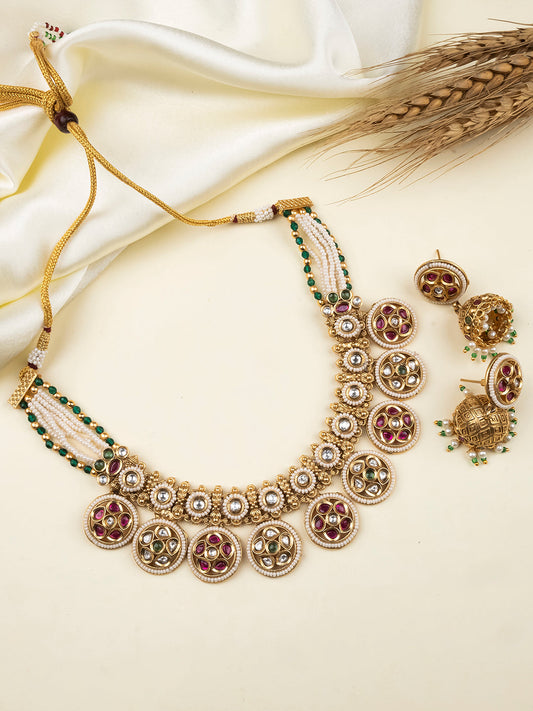
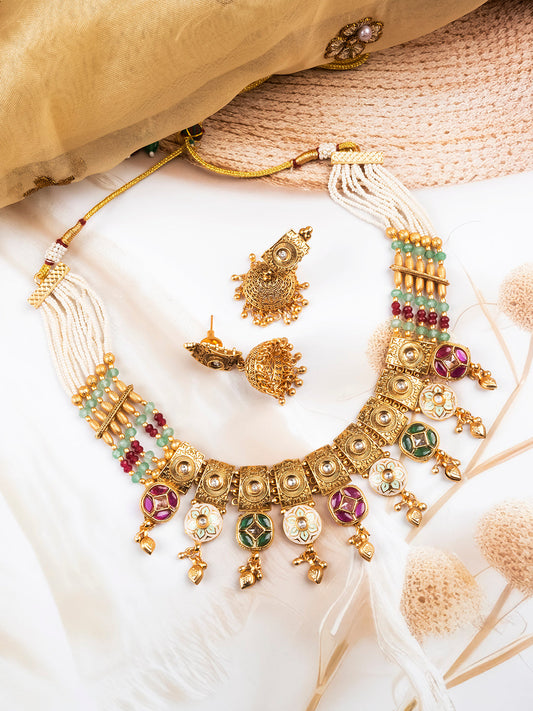
- Rajwadi Jewellery hails from the royal palaces of Rajasthan and Gujarat. It is characterized by antique brushed matte gold, uncut Polki and Kundan stone embedding, intricate Meenakari enamel, and majestic courtly motifs (peacocks, elephants, and jharokha arches).
- South Indian Bridal Jewellery traces its lineage to the historic temple dynasties of Tamil Nadu, Karnataka, Kerala, and Andhra Pradesh. It is defined by solid 22K yellow or antique reddish gold, sculpted Nakshi repousse work, sacred deity iconography (Goddess Lakshmi, Lord Ganesha), and vibrant ruby-pink Kemp stones.
Indian bridal styling is celebrated worldwide for its unparalleled opulence, regional richness, and deep cultural heritage. Yet, when an Indian bride begins assembling her bridal trousseau, she encounters two dominant powerhouses of traditional craftsmanship: the aristocratic grandeur of North/Western India's Rajwadi jewellery and the divine, sculptural sanctity of South Indian bridal jewellery.
Both traditions exude regal majesty, but their design philosophies, gemstone settings, artisan techniques, and styling rules are worlds apart. Whether you are a bride deciding which aesthetic matches your wedding day vision, or a multicultural bride looking to blend both aesthetics seamlessly, this complete guide provides an in-depth breakdown of Rajwadi jewellery vs South Indian bridal jewellery.
Cultural & Historical Lineage: Courtly Splendor vs Temple Devotion
To understand why these two styles look and feel so distinctive, we must explore their historical roots.
 The Royal Court Heritage of Rajwadi Jewellery
The word Rajwadi originates from Rajwada, meaning "royal palace" or "seat of kings." Rooted in the princely dynasties of Mewar, Marwar, and Malwa, Rajwadi ornaments were originally designed for Rajput maharanis and royal courts.
Every silhouette was crafted to project imperial dignity, dynastic pride, and aristocratic taste. As a result, Rajwadi designs incorporate palace battlements, royal hunting scenes, dancing peacocks, regal elephants (haathi), and fortress jharokhas. The overarching sentiment is one of regal authority and majestic luxury.
The Sacred Heritage of South Indian Bridal Jewellery
South Indian bridal ornaments—often centered around classic Temple Jewellery and Nakashi work — were born inside the grand stone corridors of South India's historic temple complexes (such as Thanjavur and Madurai).
Originally crafted under Chola and Pandya royal patronage, these ornaments were commissioned as Deva Abharanam — sacred offerings used to adorn the granite idols of deities. Later, temple dancers (Devadasis) were permitted to wear these divine designs during ritual temple performances. When a South Indian bride adorns herself with temple jewellery, she channels Goddess Lakshmi, symbolizing spiritual prosperity, sanctity, and divine blessings.
Craftsmanship & Metallurgy: Kundan-Lac vs. Nakashi Repousse
The technical divergence between Rajwadi jewellery and South Indian bridal jewellery is most visible at the craftsman's anvil.
Metalwork and Finishing
- Rajwadi Jewellery: Primarily celebrated for its antique matte, distressed bronze, or brushed gold patina. Artisans intentionally tone down the bright reflective sheen of new gold through specialized antique washes, allowing intricate details to look like prized family heirlooms.
- South Indian Jewellery: Renowned for deep, warm 22K yellow gold or a signature reddish antique finish (chembu polish). A hallmark technique is Nakashi work (repousse and chasing), where master artisans hand-chisel relief sculptures into solid gold plates from behind, creating three-dimensional deity figures that rise from the metal.
Gemstones and Setting Techniques
- Rajwadi Craft Techniques: Heavily relies on Jadau and Kundan stone-setting. Artisans place stones (uncut Polki diamonds, emerald cabochons, or foil-backed glass) into hollow gold beds packed with natural tree resin (lac), compressing layers of refined 24K gold foil around the edges. The reverse side is almost always embellished with vibrant Meenakari (vitreous glass enamel).
- South Indian Craft Techniques: Features bezel-set and prong-set Kemp stones (traditional unheated ruby-red and emerald-green cabochons or synthetic spinels), clustered natural seed pearls (Guttapusallu style), and uncut diamonds (Pacchi work). Enameling is minimal; the raw, sculpted gold metalwork is the undeniable star.
Head-to-Toe Ornament Comparison: Solah Shringar vs Alankaram
Both cultures practice a complete head-to-toe bridal adornment ritual—the North Indian Solah Shringar and the South Indian Bridal Alankaram. Here is how the key bridal components compare:
Head & Forehead Adornments
- Rajwadi Style: The bride wears the iconic Borla, a spherical, bell-shaped maangtikka studded with Kundan and pearls, frequently paired with a broad multi-layered Sheeshpatti (elaborate hairband matha patti) that frames the hairline with antique filigree.
- South Indian Style: The bride wears the Nethi Chutti (matha patti), accented by the Suryapirai and Chandrapirai — circular brooches symbolizing the Sun (giving life and health) and the Moon (symbolizing peace and emotional calm) pinned on either side of the hair parting.
Neckwear Silhouettes
- Rajwadi Style: The centerpiece is often a rigid, crescent-shaped choker known as the Rajputi Aad, sitting high on the collarbone. This is typically layered with a cascading Chandan Haar, Rani Haar, or multi-strand pearl and polki malas for imperial depth.
- South Indian Style: The neck is layered starting with a tight choker (Attigai or Manga choker), followed by heritage statement necklaces such as:
- Kasu Mala: A garland of overlapping gold coins stamped with images of Goddess Lakshmi.
- Manga Malai: A necklace formed of sculpted green and red paisley mango motifs.
- Guttapusallu: A heritage Andhra necklace trimmed with dense fringes of clustered seed pearls.
Waist Belts
- Rajwadi Tagdi/Kamarbandh: A flexible waist belt made of interlocking Kundan motifs, antique chains, and hanging latkan drops, designed to cinch heavy georgette or velvet lehengas.
- South Indian Vadanam/Oddiyanam: A broad, rigid gold waist belt sculpted with high-relief 3D Nakashi carvings of Goddess Lakshmi seated on a lotus, flanked by elephants. It cinches the pleated silk Kanjeevaram saree firmly at the waist.
Armlets & Hand Ornaments
- Rajwadi Hand Ornaments: Features the Haathphool (a central medallion connected by pearl chains to five rings) and heavy bangles like Pachheli, Gokharu (pointed projecting studs), and broad ivory or lacquer choodas.
- South Indian Hand Ornaments: Features the Vanki, an inverted V-shaped armlet featuring snake or peacock motifs, and thick carved antique kadas alongside stacked gold Valayal bangles.
Hair Styling
- Rajwadi Hair: Hair is usually styled into an ornate low bun covered with a sheer embroidered veil (Odhna or Dupatta), accented with floral pins or a jeweled Choti Paranda.
- South Indian Hair: The hair is styled into a long, elaborate braid adorned with Jada Billai (graduating circular gold plates pinned along the braid), capped with a Poola Jada (fresh garland of jasmine and crossandra flowers), and left unveiled.
Master Comparison Matrix: Rajwadi vs South Indian Bridal Jewellery
The following table highlights the essential parameters distinguishing both bridal traditions:
 The Bridal Decision Framework: How to Choose Your Perfect Set
When planning your bridal jewellery, consider these four styling factors to determine whether a Rajwadi or South Indian bridal set best fits your wedding aesthetic:
Match Your Draped Silhouette and Fabric
- Choose Rajwadi Jewellery if your wedding outfit is a flared silhouette—such as a heavily embroidered Raw Silk Lehenga, a Banarasi tissue drape, or a traditional Rajputi Poshak. The matte antique finish balances high-shine metallic zardosi threads without visual clutter.
- Choose South Indian Jewellery if your primary wedding attire is a handwoven pure silk drape like a Kanjeevaram, Temple Korvai, or Kasavu saree with broad gold zari borders. The bold yellow and reddish-gold Nakashi work sits flat and regal against rich silk weaves.
Factor in Your Neckline & Layering Vision
- If your blouse has a sweetheart, plunging, or square neckline, a structured Rajwadi Aad or Kundan choker creates a dramatic focal point across the collarbones.
- If your blouse features a high-neck, boat-neck, or round neckline, long cascading South Indian layers like a Kasu Mala paired with a Manga Malai elongate your torso effortlessly.
Consider Event Lighting and Photography
- Rajwadi matte jewellery absorbs harsh stage flashes, rendering softly in camera lenses and making it ideal for evening receptions and indoor banquet halls.
- South Indian gold and Kemp jewellery radiates an unmatched warm glow under natural sunlight, making it the premier choice for morning Muhurtham ceremonies and outdoor mandap rituals.
The Modern Fusion Trend: Blending Rajwadi and South Indian Styles
Who says a modern bride must choose only one? Contemporary Indian brides are celebrated for creating striking cross-cultural bridal statements by harmonizing both craft forms:
- The Kanjeevaram + Rajwadi Choker Combination: Pair a crimson or emerald Kanjeevaram silk saree with a vintage matte Rajwadi choker at the neck, anchored below by a long South Indian Kasu Mala. The stone-studded choker breaks the solid gold monotony while honoring both heritages.
- The Temple Vanki on a Lehenga: Style a contemporary designer velvet lehenga with a single sculpted Nakashi temple armlet (Vanki) or a Goddess Lakshmi Vadanam waist belt to add antique structural edge to soft embroidery.
- Unifying with Tone: When mixing both worlds, ensure the gold platings match. Pair antique-matte Rajwadi pieces with antique-finish temple pieces rather than high-shine 24K polished gold.
Care & Preservation Differences
Because their craftsmanship processes differ, their care regimens require specific handling:
- Caring for Rajwadi (Jadau/Kundan) Jewellery: Because Rajwadi jewellery incorporates natural lac resin and delicate gold foil, never expose it to water, liquid cleaners, perfumes, or extreme heat (which can soften the resin). Store pieces in airtight, cotton-lined or velvet boxes with silica gel packets.
- Caring for South Indian (Nakashi/Temple) Jewellery: Carved relief work has crevices that can trap dust and sweat. Clean gently using a soft, dry makeup brush. Avoid chemical dip solutions that can strip away intentional antique chembu oxidation or dislodge hand-set Kemp stones.
Frequently Asked Questions (FAQ)
Q1: Can a North Indian bride wear South Indian temple jewellery?
Yes, absolutely. Temple jewellery has become a pan-Indian bridal favorite. Sculpted Nakshi chokers and Lakshmi pendants look stunning when paired with deep red, maroon, and rust Banarasi lehengas or raw silk blouses for pheras.
Q2: Is Rajwadi jewellery heavier than South Indian bridal jewellery?
South Indian temple jewellery is typically heavier in pure metal weight because traditional Nakashi and repousse pieces require substantial gold thickness to chisel 3D relief carvings. Rajwadi jewellery gains its visual volume from broad stone settings, pure gold foil, and lac filling, often making it lighter in actual gold weight while offering a majestic, spread-out profile.
Q3: What is the primary difference in stone settings between both styles?
Rajwadi jewellery relies on the Kundan technique, where stones are set flush into softened gold foil over a resin base and backed with vitreous Meenakari enamel. South Indian bridal jewellery primarily uses prong or bezel settings with red Kemp cabochon stones, emeralds, and clustered seed pearls without enamel backing.
Q4: Which style is better for a morning wedding ceremony?
Both are exquisite, but South Indian bridal jewellery is especially revered for morning ceremonies (Muhurtham), as its warm 22K yellow gold and rich ruby-red Kemp stones reflect daylight beautifully against silk sarees.
Q5: How do I identify authentic Rajwadi jewellery designs?
Authentic Rajwadi designs feature an antique, non-glossy matte gold patina, courtly motifs like peacocks and royal jharokha arches, flush Kundan or Polki stone settings, and traditional Rajasthani silhouettes like the Aad, Borla, and Sheeshpatti.
Conclusion & Royal Bridal Styling with StileAdda
When comparing Rajwadi jewellery vs South Indian bridal jewellery, there is no singular winner—only two magnificent expressions of India's living artistic heritage. Whether you are captivated by the aristocratic courtly poise of a Rajwadi Aad choker and Borla, or the divine sanctity of a hand-chiseled Temple Kasu Mala and sculpted Vadanam, your bridal jewellery is a reflection of generational elegance.
Looking to curate a head-turning bridal trousseau with royal heritage? Discover StileAdda's exclusive collections of handcrafted Rajwadi bridal sets, heritage Kundan chokers, and imperial antique ornaments designed to make you feel like royalty on your most memorable day.
Tags:
Related Articles
Rajwadi Jewellery — The Complete Guide
Sep 23 2026