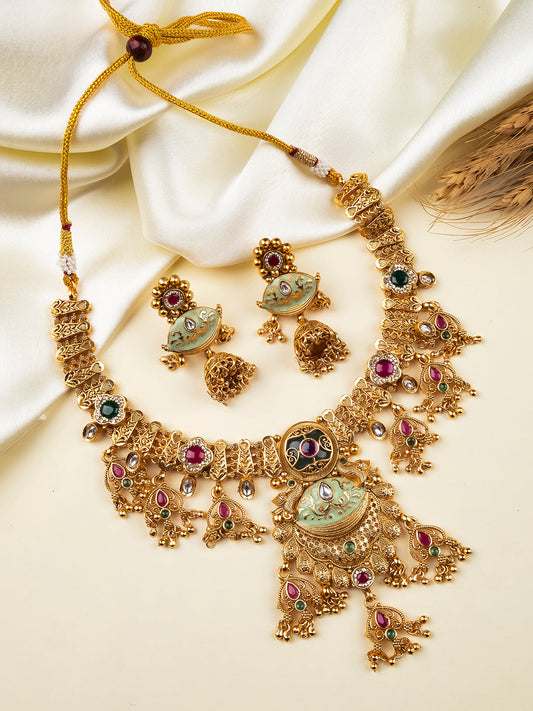

Rajwadi Jewellery vs Jadau Jewellery: The Multi-Section Craft Comparison Guide
The Quick Summary: If you are comparing traditional Indian jewellery crafts, the golden rule is understanding style vs technique:
- Rajwadi Jewellery is an overarching design style inspired by royal Rajasthani and Maratha courts, celebrated for its antique matte finishes and regal motifs.
- Jadau Jewellery is a centuries-old craftsmanship process of embedding stones (uncut Polki, Kundan, or gems) into a softened gold base using lac resin and pure gold foil.
- Meenakari is the Persian art of glass-enameling vibrant colors onto metal.
- Temple Jewellery is sacred South Indian iconography crafted in yellow gold depicting deities.
- Antique Jewellery refers to aged pieces (100+ years old) or modern pieces with a darkened, vintage chemical wash.
When building a traditional bridal trousseau or shopping for festive Indian wear, the terminology can feel like a labyrinth. You might hear a jeweller call a necklace "pure Jadau," while another labels the same silhouette "authentic Rajwadi," "traditional Meenakari," or "antique temple work."
Are these competing craftsmanship techniques, distinct regional heritages, or simply marketing buzzwords?
In this comprehensive, multi-section guide, we provide a direct, technical breakdown of Rajwadi jewellery vs Jadau jewellery, followed by detailed head-to-head comparisons against Meenakari, Temple, and Antique jewellery. By the end of this guide, you will know exactly how these iconic crafts differ, how they overlap, and which set fits your personal style.
Rajwadi Jewellery vs Jadau Jewellery: Style vs Process
The most common point of confusion among buyers is the Rajwadi jewellery vs Jadau jewellery comparison. To understand how they differ, we have to look at what happens at the artisan's workbench.
What is Jadau Jewellery? (The Technique)
Jadau is derived from the colloquial Hindi word Jadna, which literally translates to "to embed" or "to stud". Originating during the Mughal era and perfected in the royal workshops of Rajasthan and Gujarat, Jadau is an elaborate, multi-artisan jewellery-making process, not a design theme.
A single Jadau piece requires four distinct master craftsmen working in sequence:
1. The Chiteria (Designer): conceptualizes the layout and structure.
2. The Gharia (Engraver): carves hollow sockets and frames into 22K or 18K gold.
3. The Meenakar (Enameler): applies vibrant glass enamel onto the back or edges.
4. The Jadaiya (Stone Setter): packs the sockets with natural *lac* (tree resin), places uncut diamonds (Polki) or glass slabs, and compresses refined 24K gold foil (Kundan) around the stones at room temperature without soldering.
What is Rajwadi Jewellery? (The Aesthetic)
In contrast, Rajwadi jewellery is a design aesthetic and theme, translating to "belonging to the royal palace/court" (Rajwada). It is not defined by how stones are attached, but by its stately visual presence:
- Antique, dull-gold, or brushed-bronze patina.
- Heavy, imposing silhouettes like the broad Aad choker, Borla (spherical maang tikka), and Haathphool.
- Courtly motifs such as royal elephants, dancing peacocks, palace arches (jharokhas), and warrior crests.
The Verdict: Can a Piece Be Both?
Yes! Jadau is the method, while Rajwadi is the look. A bridal necklace crafted through the meticulous stone-embedding process of Jadau, but finished with an antique matte polish and Rajput court motifs, is a Rajwadi Jadau necklace.
Rajwadi Jewellery vs Meenakari Jewellery: Regal Silhouette vs Enamel Artistry
Another comparison buyers frequently make is Rajwadi jewellery vs Meenakari jewellery. While closely linked in North Indian jewelry-making, their design objectives are distinct.
Understanding Meenakari Jewellery
Meenakari is the specialized art of decorating metal surfaces with mineral glass powders fired in a kiln at high temperatures. Introduced to Jaipur in the late 16th century by Raja Man Singh-I of Amber via master craftsmen from Lahore, Meenakari is celebrated for its vivid hues of ruby red, emerald green, turquoise blue, and opaque white.
Meenakari can be applied in two ways:
- Gupt Meena (Secret Enamel): Hidden on the reverse side of Jadau/Rajwadi jewellery to protect the metal from skin perspiration.
- Khulla Meena (Exposed Enamel): Positioned front and center as the primary artistic feature of the jewellery.
Best Rajwadi Jewellery Set vs Meenakari Set: Which Should You Choose?
When deciding on the best Rajwadi jewellery set vs Meenakari set for a wedding or festival, consider your outfit's color palette and event formality:
| Styling Factor | Rajwadi Jewellery Set | Meenakari Jewellery Set |
|---|---|---|
| Visual Vibe | Somber, antique, regal, majestic | Playful, colorful, artistic, vibrant |
| Dominant Tone | Darkened antique gold, subtle stones | Bright red, royal blue, peacock green, white |
| Best Occasion | Main wedding day (pheras), reception | Mehendi, haldi, sangeet, festive pooja |
| Outfit Pairing | Heavy zardosi lehengas, Rajputi poshaks | Floral lehengas, pastel silks, Bandhani sarees |
Buyer Recommendation: Choose a Rajwadi set if your goal is grand, traditional bridal royalty where gold structure and drama take center stage. Opt for a Meenakari set if you want bright, picture-perfect pops of color that match specific shades in your festive attire.
Rajwadi Jewellery vs Temple Jewellery: Royal Court vs. Sacred Sanctum
A major regional comparison in Indian craftsmanship is Rajwadi jewellery vs temple jewellery. Although both feature bold, sculpted gold, they hail from entirely different cultural origins.
Origins and Motifs
-
Temple Jewellery: originated in the 9th-century Chola and Pandya dynasties of South India (centered around Nagercoil, Tamil Nadu). Designed originally to adorn temple deities and later adapted for Devadasi temple dancers, it is deeply sacred. Its signature motifs include Goddess Lakshmi, Lord Ganesha, temple spires (gopurams), coins (Kasumala), and sacred swans (Annapakshi).
-
Rajwadi Jewellery: stems from the royal courts of Western and Northern India (Mewar, Marwar, and Maratha dynasties). Its focus is secular courtly luxury, power, and dynastic prestige, showcasing royal insignias, hunting motifs, and floral scrolls.
Craftsmanship & Stones
- Temple jewellery is typically crafted using solid 22K yellow gold with fine filigree, repoussé (metal embossing), and accented primarily with red cabochon rubies and South Sea pearls.
- Rajwadi jewellery relies heavily on stone-embedding (Jadau/Kundan), enamel backing (Meenakari), and an oxidized or matte finish.
Outfit Pairing
- Pair Temple jewellery with traditional South Indian weaves like Kanjeevaram, Kasavu, or Mysore silk sarees.
-
Pair Rajwadi jewellery with North Indian bridal attire such as Raw Silk Lehengas, Banarasi brocades, and Rajasthani Poshaks.
Rajwadi Jewellery vs Antique Jewellery: Cultural Lineage vs Distressed Finish
Shoppers often confuse Rajwadi jewellery vs antique jewellery because both share a characteristic non-shiny, vintage tone. However, the difference lies in classification scope.
Broader World of Antique Jewellery
"Antique" is a universal descriptive term with two definitions:
1. True Historical Antiques: Any authentic piece of jewellery that is at least 100 years old (possessing historical and collectible value).
2. Commercial Antique Finish: Modern jewellery that undergoes specialized chemical oxidation, black-rhodium washes, or matte electroplating to intentionally remove the high-sheen yellow reflection of new gold, giving it a weathered, centuries-old appearance.
"Antique jewellery" can encompass Victorian brooches, Art Deco pendants, antique South Indian temple pieces, or vintage tribal silver.
Where Rajwadi Fits In
Rajwadi jewellery is a specific regional sub-category. While almost all modern Rajwadi jewellery is treated with an antique finish, not all antique jewellery is Rajwadi! Rajwadi strictly preserves the structural forms (Aad, Chandan Haar, Borla) and courtly iconography of Western India's princely states.
Master Comparison Matrix: 5 Indian Jewellery Crafts at a Glance
The following table summarizes the five distinct jewellery classifications:
| Craft Style | Classification | Regional Origin | Key Materials | Signature Motifs | Primary Finish |
|---|---|---|---|---|---|
| Rajwadi | Design Aesthetic / Style | Rajasthan & Maharashtra | Gold, brass/copper, Polki, Kundan | Peacocks, elephants, royal arches | Matte, antique, or oxidized gold |
| Jadau | Craft Setting Technique | Mughal courts, Rajasthan | 22K/24K gold foil, lac resin, stones | Geometric stone grids, floral clusters | Flush stone surface, Meenakari back |
| Meenakari | Surface Enameling Craft | Jaipur (Lahore origin) | Glass enamel powders, gold/silver | Lotus petals, parakeets, vines | Glossy, colorful vitreous glaze |
| Temple | Sacred Iconography Style | Tamil Nadu (South India) | Solid 22K gold, rubies, pearls | Goddess Lakshmi, Ganesha, Gopurams | Classic deep yellow gold, Nakshi repoussé |
| Antique | Finish / Age Category | Global / Pan-Indian | Any metal alloy or precious gold | Varies (Victorian, Tribal, or Royal) | Chemically darkened, oxidized, dull patina |
Frequently Asked Questions (FAQ)
Q1: What is the main Rajwadi jewellery vs Jadau jewellery difference?
The main difference is that **Rajwadi** is an aesthetic design style inspired by royal courts, while **Jadau** is the technical crafting method used to embed stones into a gold base with pure gold foil and resin. A piece of jewellery can be both Rajwadi in style and Jadau in technique.
Q2: Between Rajwadi jewellery vs Meenakari jewellery, which is more durable?
Rajwadi jewellery with an antique gold plating or heavy metalwork is generally more resilient to surface wear. Meenakari involves glass enamel, which can chip or crack if dropped on hard surfaces or exposed to high heat and acidic chemicals.
Q3: Can I wear Rajwadi jewellery with a South Indian Kanjeevaram saree?
Yes. While Temple jewellery is the traditional match for Kanjeevaram sarees, a matte-finish Rajwadi choker or layered Rani Haar provides a regal, cross-cultural bridal statement that pairs exceptionally well with rich gold zari borders.
Q4: What makes the best Rajwadi jewellery set vs Meenakari set for brides?
The best choice depends on the ceremony: a heavy Rajwadi set is best suited for the grand solemnity of the wedding Pheras or Reception, while a colorful Meenakari set is the top choice for vibrant pre-wedding celebrations like the Mehendi or Sangeet.
Q5: Is all antique jewellery considered Rajwadi?
No. Antique jewellery is a broad category describing either 100+ year-old pieces or modern pieces with an aged, oxidized finish. Rajwadi jewellery is a distinct cultural lineage featuring the specific silhouettes and motifs of Indian royal palaces.
Conclusion & Call to Action
Distinguishing between Rajwadi, Jadau, Meenakari, Temple, and Antique jewellery allows you to appreciate the generational artistry behind Indian adornments. Whether you choose the complex stone-embedding of Jadau, the vibrant storytelling colors of Meenakari, the divine grace of South Indian Temple motifs, or the regal antique presence of Rajwadi ornaments, each style connects you to a timeless chapter of Indian heritage.
Ready to find your signature royal piece? Explore StileAdda's exclusive collections of handcrafted Rajwadi, Jadau, and Meenakari jewellery sets to elevate your wedding and festive celebrations with true imperial grace!
Tags: